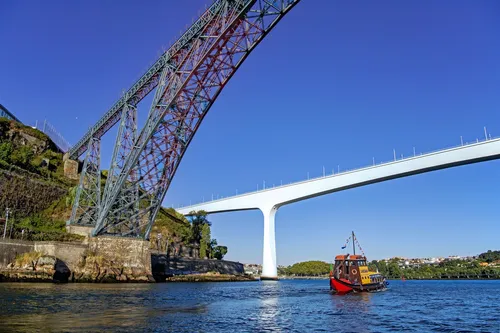
Ponte de São João and the Bridge Maria Pia are two iconic railway bridges in Porto, Portugal, spanning the Douro River and representing significant feats of engineering and design.
The Bridge Maria Pia, completed in 1877, was designed by the renowned engineer Gustave Eiffel, famous for the Eiffel Tower in Paris. This bridge was the first major work of Eiffel outside of France and is a testament to 19th-century engineering. The bridge features a single arch design with a span of 160 meters, making it a pioneering structure of its time. It was an essential link for the Lisbon-Porto railway line, facilitating the movement of people and goods across the Douro and contributing to Porto's economic growth. In 1991, the Ponte de São João was inaugurated to replace the aging Bridge Maria Pia for railway traffic. Designed by Edgar Cardoso, a prominent Portuguese civil engineer, it reflects advancements in engineering with its clean, modern lines and robust structure. The bridge consists of three spans supported by two piers, showcasing a minimalist aesthetic that contrasts with the ornate ironwork of its predecessor. Both bridges are not only functional but also contribute to Porto's rich architectural landscape. Visitors can enjoy views of these engineering marvels from various vantage points along the river, appreciating their historical and contemporary significance in connecting the city.
The Bridge Maria Pia, completed in 1877, was designed by the renowned engineer Gustave Eiffel, famous for the Eiffel Tower in Paris. This bridge was the first major work of Eiffel outside of France and is a testament to 19th-century engineering. The bridge features a single arch design with a span of 160 meters, making it a pioneering structure of its time. It was an essential link for the Lisbon-Porto railway line, facilitating the movement of people and goods across the Douro and contributing to Porto's economic growth. In 1991, the Ponte de São João was inaugurated to replace the aging Bridge Maria Pia for railway traffic. Designed by Edgar Cardoso, a prominent Portuguese civil engineer, it reflects advancements in engineering with its clean, modern lines and robust structure. The bridge consists of three spans supported by two piers, showcasing a minimalist aesthetic that contrasts with the ornate ironwork of its predecessor. Both bridges are not only functional but also contribute to Porto's rich architectural landscape. Visitors can enjoy views of these engineering marvels from various vantage points along the river, appreciating their historical and contemporary significance in connecting the city.
🗺 Map
🎫 Tourist attractions
🌦 Weather information
Get weather information, and much more, from the app. Download it for free!
🚕 How to get there?
Get routes information (by car, walking, public transport, etc), and much more, from the app. Download it for free!